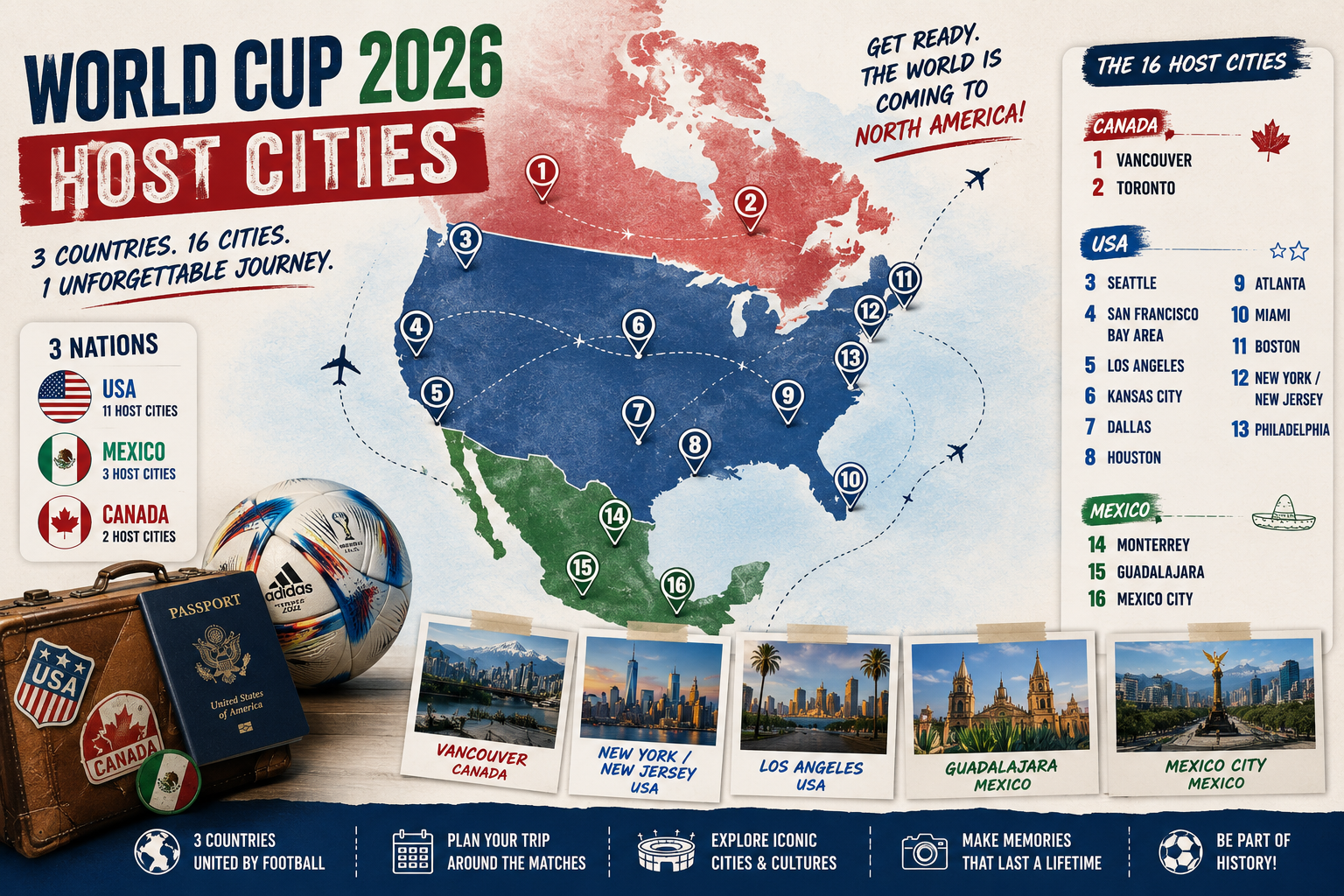
World Cup 2026 Travel Guide: Top US Destinations to Explore Between Matches Attending the 2026 FIFA World Cup is about far more than watching 90 minutes of football. With matches spread across multiple regions of the United States, this tournament offers a rare opportunity to experience one of the world’s most diverse travel destinations while […]
Disclaimer: This post contains affiliate links. We may earn a small commission if you make a purchase through them, at no extra cost to you. Read our full Affiliate Disclosure here.
World Cup 2026 Travel Guide: Top US Destinations to Explore Between Matches
Attending the 2026 FIFA World Cup is about far more than watching 90 minutes of football. With matches spread across multiple regions of the United States, this tournament offers a rare opportunity to experience one of the world’s most diverse travel destinations while following your favorite team from city to city.
Unlike previous World Cups hosted in relatively compact countries, the United States requires a different mindset. Flying from one host city to another can take several hours, road trips often cover hundreds of miles, and each region feels like its own destination with distinct landscapes, food, culture, and climate. The difference between a stressful tournament and an unforgettable vacation often comes down to how well you plan your route.
Many international visitors make the mistake of booking flights based solely on match dates. They underestimate travel times, overlook nearby attractions, or spend unnecessary money bouncing between opposite sides of the country. A smarter approach is to organize your itinerary by region, allowing you to enjoy famous cities, national parks, scenic highways, and local experiences during the days between matches.
Whether you’re cheering from the stands in New York, exploring California’s coastline after a game in Los Angeles, or tasting authentic Texas barbecue before kickoff in Dallas, every stop can become part of an unforgettable American adventure.
This comprehensive World Cup 2026 Travel Guide will help you build a practical itinerary that combines football with sightseeing, regional cuisine, iconic landmarks, and efficient transportation. Instead of rushing through airports every few days, you’ll discover how to experience the best of the United States while staying close to your tournament schedule.
Why Regional Planning Matters More Than Ever
One of the biggest surprises for first-time visitors is the sheer size of the United States.
Many travelers compare America to Europe and assume moving between cities is simple. In reality, traveling from Seattle to Miami covers roughly the same distance as flying across much of Europe. Even routes that appear close on a map can require several hours of driving or expensive domestic flights.
For that reason, it’s usually best to group your matches into one geographic region whenever possible.
For example:
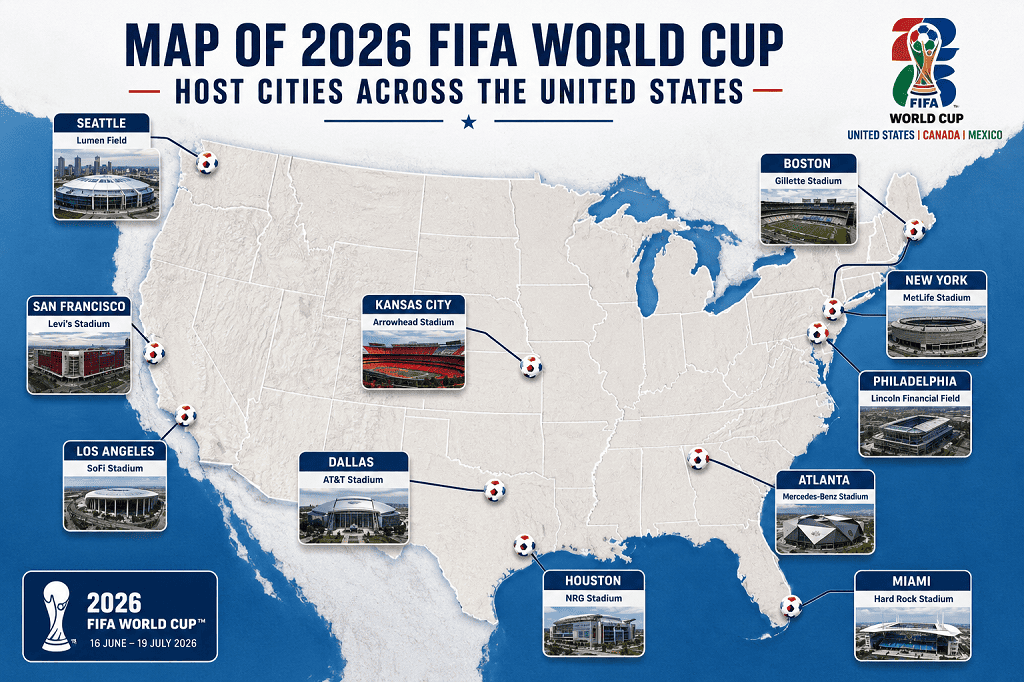
- Northeast: New York/New Jersey, Philadelphia, and Boston
- West Coast: Los Angeles, San Francisco Bay Area, and Seattle
- Southern & Texas: Dallas, Houston, and Atlanta
Planning around these regional clusters allows you to:
- Spend less time inside airports.
- Save hundreds of dollars on transportation.
- Experience more attractions between matches.
- Reduce travel fatigue during a busy tournament schedule.
- Enjoy local culture instead of constantly packing and unpacking.
Think of each region as its own vacation rather than trying to “see all of America” in two weeks. You’ll return home with better memories—and far less stress.
Quick Planning Tips Before You Arrive
Before diving into each region, keep these practical travel tips in mind.
Book Domestic Flights Early
Airfares between World Cup host cities are expected to increase significantly around match days. Booking flights several months in advance typically provides the widest selection and better prices.
Don’t Stay Beside the Stadium
Hotels within walking distance of World Cup venues are likely to command premium rates.
Instead, consider neighborhoods connected by public transportation. You’ll often save money while enjoying a better local atmosphere, more restaurants, and easier access to sightseeing.
Leave Room Between Matches
Avoid scheduling back-to-back games in cities that require cross-country travel.
Unexpected weather, airport delays, or heavy traffic can quickly disrupt an overly ambitious itinerary.
Pack for Multiple Climates
During June and July, you could experience:
- Cool mornings in Seattle
- Comfortable evenings in Boston
- Dry heat across Texas
- Sunny beach weather in Southern California
Packing versatile clothing is much easier than carrying separate outfits for every destination.
1. The Northeast Cluster: History, Skylines, and America’s Most Walkable Cities
If your tickets include matches in New York/New Jersey (MetLife Stadium), Boston (Gillette Stadium), or Philadelphia (Lincoln Financial Field), you’re arguably visiting the easiest World Cup region to explore.
Unlike much of the United States, these cities are connected by reliable rail service, making it possible to travel without renting a car. Historic neighborhoods, famous museums, waterfront districts, and world-class restaurants are all within easy reach.
Rather than treating these cities as separate destinations, think of them as one connected travel corridor stretching along the East Coast.
For visitors arriving from overseas, this region also offers some of America’s richest combination of history, architecture, sports culture, and food—all within a relatively compact area.
New York City: More Than Just Times Square
New York rarely needs an introduction, but many first-time visitors only scratch the surface.
While Times Square, the Empire State Building, and the Statue of Liberty remain iconic attractions, the city’s greatest strength is simply wandering through its neighborhoods.
Spend a morning walking through Central Park before the crowds arrive. Explore Greenwich Village for independent cafés and tree-lined streets. Visit Chelsea Market for lunch before strolling along the High Line, a former elevated railway transformed into one of New York’s most unique urban parks.
If your schedule allows, head across the East River to Brooklyn.
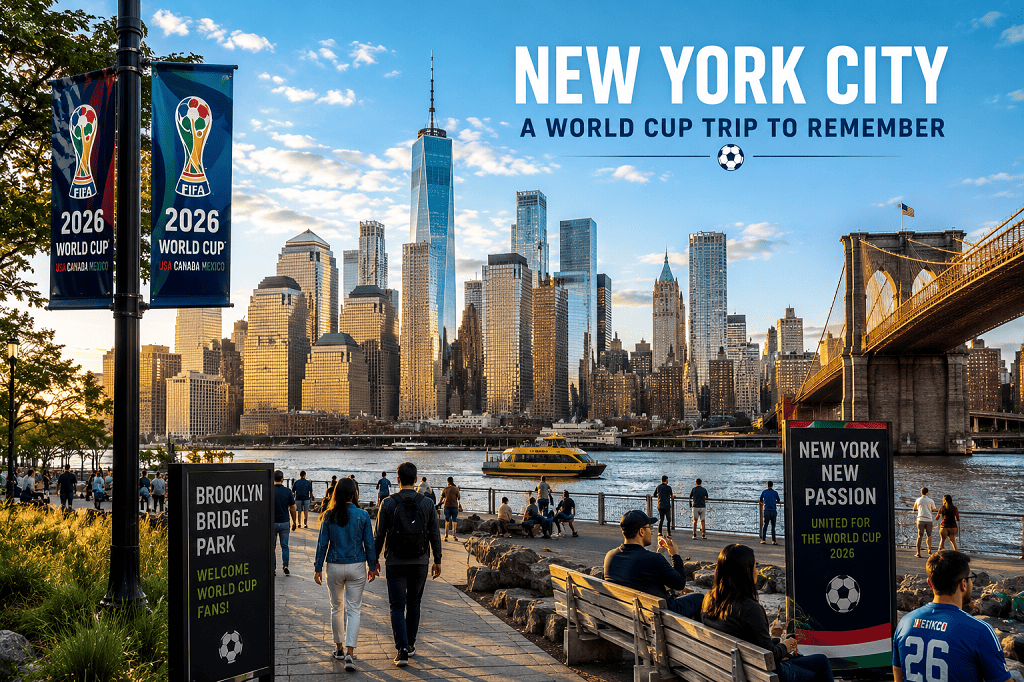
The Brooklyn Bridge is spectacular at sunrise, while Brooklyn Bridge Park offers some of the best skyline views anywhere in the city.
Local Tip
Instead of eating every meal around Times Square, venture into neighborhoods like Hell’s Kitchen, Koreatown, or the Lower East Side. You’ll find better food, shorter lines, and a much more authentic New York experience.
Best Attractions Between Match Days
If you have one full day available:
- Central Park
- Top of the Rock Observation Deck
- Fifth Avenue
- Rockefeller Center
- Broadway evening performance
If you have two or three days:
- Brooklyn Bridge
- DUMBO Waterfront
- High Line
- Chelsea Market
- One World Observatory
- Staten Island Ferry
- Metropolitan Museum of Art
Visitors interested in sports should also consider Yankee Stadium or Citi Field if baseball season aligns with their travel dates.
Day Trip Option: Washington, D.C.
Many international visitors overlook how easy it is to reach Washington from New York by train.
If you have several days between matches, America’s capital offers a completely different atmosphere.
Highlights include:
- National Mall
- Lincoln Memorial
- Smithsonian Museums
- U.S. Capitol
- Georgetown Waterfront
Most Smithsonian museums offer free admission, making Washington one of the best-value destinations in the country.
Boston: Where American History Comes Alive
Boston is one of America’s oldest cities and an excellent destination for travelers who enjoy history mixed with walkable neighborhoods.
The city’s compact downtown makes it ideal for exploring on foot.
The famous Freedom Trail stretches approximately 2.5 miles and connects sixteen historic landmarks related to the American Revolution, including churches, meeting houses, cemeteries, and museums.
Even travelers with limited historical knowledge often find the route surprisingly engaging because nearly every stop tells part of the story that shaped modern America.
Beyond history, Boston has an energetic waterfront, outstanding seafood, and one of the country’s strongest university cultures thanks to nearby Harvard University and MIT.
Don’t Miss in Boston
If you’re spending two days here, consider this simple itinerary.
Morning:
- Walk the Freedom Trail.
- Visit Faneuil Hall Marketplace.
Afternoon:
- Explore the North End.
- Try authentic Italian pastries.
- Walk along Boston Harbor.
Evening:
- Watch the sunset from the Charles River Esplanade.
- Enjoy fresh New England lobster or clam chowder.
During baseball season, catching a game at Fenway Park is another memorable experience—even for visitors who aren’t dedicated baseball fans.
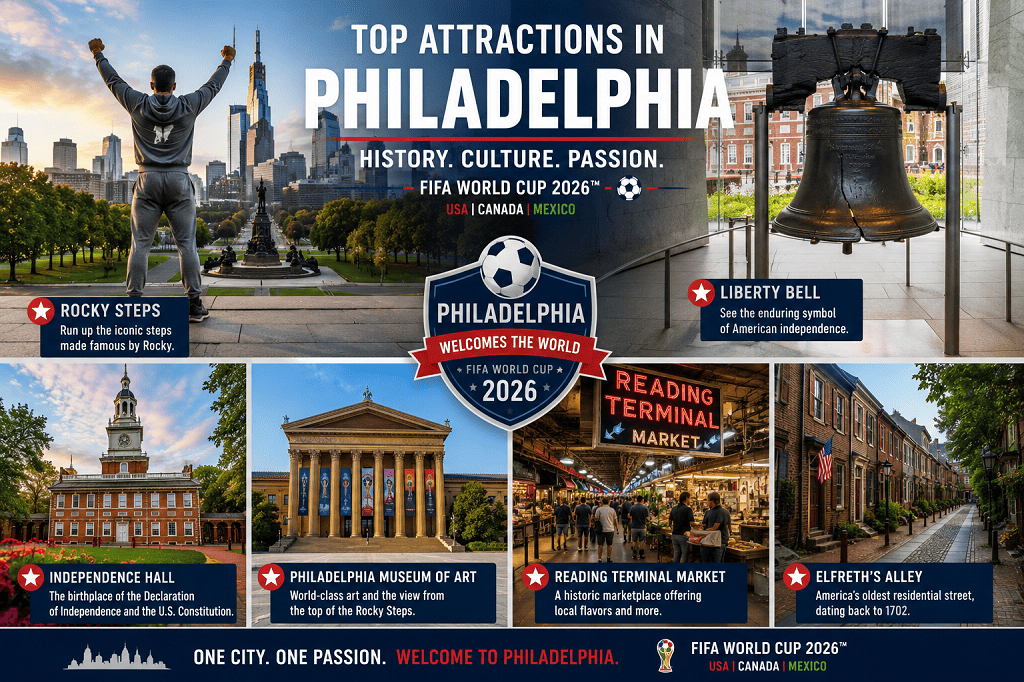
Philadelphia: America’s Birthplace
Philadelphia often receives less attention than New York or Boston, yet many travelers leave saying it was one of the biggest surprises of their trip.
The city combines major historical landmarks with an excellent food scene and a relaxed atmosphere that’s noticeably different from Manhattan.
History enthusiasts shouldn’t miss:
- Independence Hall
- Liberty Bell
- Independence National Historical Park
Movie fans usually head straight to the famous Rocky Steps outside the Philadelphia Museum of Art before taking the traditional victory photo at the top.
But Philadelphia’s greatest attraction may actually be its food.
Yes, you’ll want to try an authentic Philly cheesesteak—but don’t stop there.
Reading Terminal Market is one of America’s oldest public markets and offers everything from Pennsylvania Dutch specialties to fresh seafood, roast pork sandwiches, international cuisine, and locally made desserts.
It’s an excellent place to sample multiple dishes without committing to a full restaurant meal.
East Coast Transportation Tips
One of the biggest advantages of this region is that you don’t necessarily need a rental car.
The Northeast Corridor rail network connects Boston, New York, Philadelphia, Baltimore, and Washington, D.C., making train travel both convenient and comfortable.
For many visitors, trains eliminate the stress of traffic, parking fees, and airport security while allowing city-center to city-center travel.
The Amtrak Acela service is particularly useful for travelers moving between Boston, New York, and Philadelphia.
If you’re staying primarily within city centers, public transportation is usually more practical than driving.

Traveling between multiple East Coast cities means you’ll rely heavily on your smartphone for digital tickets, navigation, translation apps, and real-time transit updates. Before purchasing an international eSIM or data plan, explore our Tech Reviews & Picks section to compare connectivity options that perform well across busy rail stations, underground subway systems, and crowded stadium environments.
Sample 5-Day Northeast World Cup Itinerary
Here’s one practical way to combine football with sightseeing.
Day 1: Arrive in New York, explore Midtown Manhattan.
Day 2: Watch your World Cup match at MetLife Stadium.
Day 3: Take an early train to Philadelphia. Visit Independence Hall, Reading Terminal Market, and stay overnight.
Day 4: Continue to Boston. Walk the Freedom Trail and enjoy the waterfront.
Day 5: Return for your next World Cup match or continue your journey to another regional cluster.
This itinerary minimizes airport transfers while allowing you to experience three of America’s most historic cities in less than a week.
Why the Northeast Is Perfect for First-Time Visitors
If this is your first trip to the United States, the Northeast offers one of the easiest introductions to the country.
Cities are relatively close together, public transportation is well developed, and you’ll experience everything from colonial history and iconic skylines to world-famous museums, diverse neighborhoods, and unforgettable local food.
More importantly, you won’t spend half your vacation sitting on airplanes.
Instead, you’ll spend your time walking through centuries of American history, discovering unique local neighborhoods, and enjoying the atmosphere that makes the East Coast one of the most rewarding regions to explore during the 2026 FIFA World Cup.
2. The West Coast Cluster: Scenic Coastlines, National Parks, and California Road Trips
If your World Cup itinerary includes Los Angeles (SoFi Stadium), San Francisco Bay Area (Levi’s Stadium), or Seattle (Lumen Field), you’re in for one of the most visually spectacular regions in North America.
Unlike the Northeast, where history and walkable cities dominate the experience, the West Coast is all about dramatic landscapes, ocean views, outdoor adventures, and unforgettable road trips.
This is the region where many visitors finally understand just how geographically diverse the United States really is.
Within a single week, you could be walking along Southern California beaches, driving beside towering Pacific cliffs, hiking through ancient redwood forests, and watching snow-capped volcanoes rise above evergreen forests in Washington State.
The key to enjoying this region is not trying to rush it.
California alone is much larger than many international visitors expect. Instead of attempting to visit every major city, focus on one or two destinations that fit naturally between your match schedule.
Los Angeles: Entertainment Beyond Hollywood
Los Angeles is one of the most recognizable cities in the world, but it’s also one of the easiest places to misunderstand.
Many first-time visitors expect to spend all their time in Hollywood. In reality, Los Angeles is a collection of diverse neighborhoods spread across a massive metropolitan area. The real charm comes from exploring different parts of the city rather than staying in one tourist district.
Of course, iconic attractions like the Hollywood Walk of Fame, Griffith Observatory, and Universal Studios Hollywood deserve a place on your itinerary.
But if you’re looking for a more authentic Southern California experience, spend time along the coast.
Start your morning with a walk along Venice Beach before cycling to Santa Monica. Browse the boutiques on Abbot Kinney Boulevard, watch surfers catch waves in the Pacific, and stay for sunset at the Santa Monica Pier.
The relaxed atmosphere is a welcome contrast to the excitement of match day.
Local Tip
Traffic in Los Angeles is legendary—and for good reason.
Instead of trying to squeeze five attractions into one day, group activities by neighborhood. Visiting Santa Monica, Venice, and Malibu on the same day is far more practical than driving back and forth across the city.
Beyond the City: Malibu and the Pacific Coast
If your schedule allows an extra day, head north toward Malibu.
The coastline quickly becomes quieter, offering beautiful beaches, dramatic cliffs, and scenic viewpoints that feel far removed from downtown Los Angeles.
Continue farther north and you’ll eventually join one of America’s most famous drives: California’s Highway 1, also known as the Pacific Coast Highway.
Few road trips capture the spirit of California better.
Ocean cliffs, charming coastal towns, vineyards, sea lions, and countless scenic overlooks make this route a destination in itself rather than simply a way to reach another city.
The Pacific Coast Highway: One of America’s Greatest Road Trips
For travelers with three or four days between matches, renting a car and driving part of the Pacific Coast Highway is one of the best travel experiences available during the World Cup.
Some of the highlights include:
- Big Sur
- Bixby Creek Bridge
- Monterey
- Carmel-by-the-Sea
- Morro Bay
- Hearst Castle
- Pismo Beach
Rather than racing through the drive, allow time to stop frequently.
Some of the most memorable moments happen unexpectedly—watching elephant seals resting on the beach, discovering a quiet coastal café, or simply pulling over to admire the Pacific Ocean stretching toward the horizon.
Driving Tip
Fuel stations become less frequent along some sections of Highway 1.
Whenever your tank reaches half full, it’s worth topping up rather than assuming another station will appear around the next corner.
San Francisco Bay Area: Innovation Meets Natural Beauty
Although Levi’s Stadium is located in Santa Clara rather than downtown San Francisco, the Bay Area offers enough attractions to fill an entire week.
Most visitors begin with the classics:
- Golden Gate Bridge
- Fisherman’s Wharf
- Alcatraz Island
- Cable Cars
- Lombard Street
These landmarks are popular for good reason.
However, one of the city’s greatest strengths is simply exploring its neighborhoods.
North Beach offers outstanding Italian restaurants.
The Mission District showcases colorful murals and excellent Mexican cuisine.
The Ferry Building Marketplace combines local food vendors, artisan products, and waterfront views.
Each neighborhood has its own personality.
Day Trips From San Francisco
If football isn’t your only reason for visiting California, several outstanding destinations sit within easy driving distance.
Napa Valley
Wine lovers can spend a relaxing day touring vineyards, enjoying farm-to-table restaurants, and sampling some of California’s best wines.
Muir Woods National Monument
Home to towering coastal redwoods, Muir Woods offers a peaceful escape just north of San Francisco.
Walking among trees that are hundreds of years old provides a completely different perspective on California’s natural beauty.
Yosemite National Park
If you have at least two or three free days, Yosemite deserves serious consideration.
Granite cliffs, waterfalls, giant sequoias, and alpine scenery make it one of America’s most iconic national parks.
Summer is an especially popular season, so advance planning is highly recommended.
Seattle: Coffee, Mountains, and the Pacific Northwest
Seattle provides a completely different atmosphere from California.
Surrounded by water, forests, and mountains, the city blends urban life with outdoor adventure more naturally than almost anywhere else in the country.
Many visitors begin at Pike Place Market.
Beyond the famous fish market and the original Starbucks store, the surrounding streets are filled with independent cafés, bookstores, local artists, and waterfront restaurants.
After exploring downtown, head to Kerry Park for one of Seattle’s best skyline views.
On a clear day, Mount Rainier dominates the horizon.
It’s one of those views that photographs never fully capture.
Explore Washington’s Incredible Nature
One of Seattle’s greatest advantages is its proximity to spectacular national parks.
Mount Rainier National Park
Only a few hours from downtown, Mount Rainier offers hiking trails, alpine meadows, waterfalls, and panoramic mountain scenery.
Wildflower season during summer is especially beautiful.
Olympic National Park
Few places in America combine so many different ecosystems.
Within one park you can explore:
- Temperate rainforests
- Rugged Pacific beaches
- Snow-covered mountains
- Crystal-clear lakes
If you have several days between matches, Olympic National Park is easily worth the journey.
Transportation Across the West Coast
This is where many international visitors underestimate travel times.
Although Los Angeles, San Francisco, and Seattle appear connected on a map, distances are enormous.
For example:
- Los Angeles to San Francisco is approximately six to seven hours by car.
- San Francisco to Seattle is over twelve hours of driving.
- Los Angeles to Seattle covers more than 1,100 miles.
Because of these distances, combining different transportation methods usually works best.
For travel within California, renting a car provides maximum flexibility.
For longer journeys between California and Washington, domestic flights are generally the most efficient option.
Trying to drive the entire West Coast during a short tournament schedule often leaves little time for sightseeing.
Practical Tips for Renting a Car
Road trips are one of the highlights of traveling across the western United States, but a little preparation makes the experience much smoother.
Before leaving the rental office:
- Download offline maps.
- Check fuel policies.
- Confirm unlimited mileage.
- Inspect the vehicle for existing damage.
- Carry both digital and printed reservation details.
Parking in downtown San Francisco can be expensive, while many beach communities charge seasonal parking fees.
Budgeting for these small expenses in advance helps avoid unpleasant surprises later.
What Makes the West Coast Unique?
Every region of the United States has its own identity, but nowhere feels quite like the Pacific Coast.
One morning you might be watching surfers in Santa Monica.
The next day you’re hiking among giant redwoods.
A few days later you’re enjoying fresh seafood beside Seattle’s waterfront before boarding a ferry to explore nearby islands.
That incredible variety is exactly what makes this region such a rewarding addition to any World Cup itinerary.
Rather than rushing from stadium to stadium, allow yourself enough time to experience the landscapes that have inspired generations of travelers, photographers, filmmakers, and outdoor enthusiasts.
3. The Southern & Texas Cluster: World-Class Barbecue, Space Exploration, and Southern Hospitality
If your team is scheduled to play in Dallas (AT&T Stadium), Houston (NRG Stadium), or Atlanta (Mercedes-Benz Stadium), you’re heading into one of America’s friendliest and most flavorful regions.
While these cities are known for their impressive sports venues, they also offer a completely different side of the United States compared with the Northeast or West Coast.
Expect bigger portions, warmer weather, vibrant music scenes, and a pace of life that encourages visitors to slow down and enjoy the experience.
Summer temperatures regularly climb above 90°F (32°C), so planning outdoor activities for the morning or evening is often more comfortable.
Dallas: Modern Texas with Western Roots
Dallas is one of the fastest-growing metropolitan areas in the United States and serves as an excellent base for exploring North Texas.
The city combines modern architecture, professional sports, excellent museums, and a strong cowboy heritage.
Between matches, visit:
- The Sixth Floor Museum at Dealey Plaza
- Dallas Arts District
- Klyde Warren Park
- Reunion Tower Observation Deck
Sports fans may also enjoy touring AT&T Stadium, one of the largest and most technologically advanced stadiums in the world.
Experience Authentic Texas Barbecue
No visit to Texas feels complete without barbecue.
Forget the quick sandwiches served at airports.
Traditional Texas brisket is smoked for up to 16 hours over hardwood, creating tender meat with a distinctive smoky flavor.
Some of the state’s most respected barbecue restaurants routinely sell out before the afternoon.
Popular stops include:
- Terry Black’s BBQ
- Cattleack Barbeque
- Pecan Lodge
Don’t be surprised if locals line up long before opening time.
Great barbecue in Texas is worth waiting for.
Houston: America’s Space City
Houston offers one of the most unique attractions of the entire tournament.
Space Center Houston provides visitors with an inside look at NASA’s human spaceflight program.
Highlights include:
- Historic Mission Control exhibits
- Saturn V rocket
- Space Shuttle replica
- Astronaut training displays
- Genuine lunar rock samples
Even travelers with little interest in science often find themselves spending an entire day here.
It’s one of the few places where you can truly appreciate the scale of America’s space exploration program.
More Than NASA
Houston is also one of the most culturally diverse cities in the United States.
Its international food scene is exceptional.
Visitors can enjoy:
- Vietnamese cuisine
- Mexican street food
- Gulf Coast seafood
- Texas barbecue
- Authentic Tex-Mex restaurants
Food lovers could easily spend several days exploring different neighborhoods without repeating a meal.
Atlanta: History Meets Modern Culture
Atlanta offers another completely different perspective on American history.
The city played a central role in the Civil Rights Movement and continues to celebrate that heritage through museums and historic landmarks.
The Martin Luther King Jr. National Historical Park is one of the city’s most meaningful attractions.
Nearby, the National Center for Civil and Human Rights provides deeper context for understanding modern American history.
Families may also enjoy:
- Georgia Aquarium
- World of Coca-Cola
- Centennial Olympic Park
All are conveniently located within downtown Atlanta.
Why This Region Surprises So Many Visitors
Many international travelers arrive expecting only football.
Instead, they discover:
- Some of America’s best food.
- Friendly local communities.
- Rich musical traditions.
- Space exploration history.
- Excellent road trip opportunities.
For anyone who enjoys great food, live music, and a slower pace between matches, the Southern and Texas cluster often becomes one of the most memorable parts of the entire World Cup journey.
4. Packing & Survival Gear for a Multi-City World Cup Adventure
Following the FIFA World Cup across the United States is very different from taking a typical city vacation.
One day you may be navigating a busy subway station in New York, the next you’re driving California’s coastal highways, and a few days later you’re walking several miles through downtown Dallas before kickoff.
Packing the right gear isn’t about bringing more—it’s about bringing smarter.
The goal is to stay comfortable, organized, and prepared without carrying unnecessary weight from one destination to the next.
Below are the travel essentials that consistently make the biggest difference during multi-city trips across the United States.
Choose a Carry-On That Works for Every Destination
Every domestic flight adds another opportunity for delayed checked baggage.
Whenever possible, travel with a carry-on suitcase and a versatile daypack.
A well-designed backpack should comfortably carry:
- Passport
- Match tickets
- Laptop or tablet
- Water bottle
- Portable charger
- Light jacket
- Camera
- Travel documents
Look for padded shoulder straps, weather-resistant materials, and multiple compartments to keep valuables organized throughout long travel days.
Why It Matters
Several U.S. airlines charge additional fees for oversized carry-on luggage or checked baggage.
Packing efficiently not only saves money but also allows you to move more quickly through airports, train stations, and stadium security.
If you’re looking for travel-tested options, explore our Gear Reviews & Guides collection, where we compare backpacks, carry-on luggage, and travel accessories designed specifically for frequent travelers.
Bring a Reliable Fast-Charging Power Bank
Your smartphone quickly becomes your most important travel companion during the World Cup.
You’ll likely use it for:
- Digital boarding passes
- Stadium tickets
- Google Maps
- Translation apps
- Mobile payments
- Restaurant reservations
- Ride-share services
- Photography
Long sightseeing days combined with constant GPS usage can drain a battery much faster than expected.
A compact power bank with USB-C Power Delivery (PD) fast charging allows you to recharge your phone while waiting for a train or enjoying lunch between attractions.
Rather than choosing the largest battery available, prioritize one that balances capacity, charging speed, and airline compliance.
Many experienced travelers find that a lightweight, airline-approved power bank provides the best combination of convenience and performance.
For the latest TSA-friendly recommendations, visit our Tech Reviews & Picks section, where we regularly test portable charging solutions for real-world travel.
Don’t Forget a Reusable Water Bottle
Summer temperatures during the World Cup can vary dramatically depending on where you’re traveling.
While Seattle may feel pleasantly cool, cities such as Dallas, Houston, and Atlanta often experience intense afternoon heat.
Purchasing bottled water several times each day quickly becomes expensive.
An insulated reusable bottle helps keep drinks cold throughout long sightseeing days and can easily be refilled at airports, hotels, and many public facilities.
It’s one of the simplest ways to stay hydrated while reducing both travel costs and plastic waste.
Dress for Multiple Climates
One of the most common mistakes international visitors make is packing for only one type of weather.
During a multi-city World Cup trip, you could experience:
- Coastal fog in San Francisco
- Warm evenings in New York
- Humid afternoons in Atlanta
- Dry Texas heat
- Cool mornings around Seattle
Instead of packing bulky clothing, bring lightweight layers that can be mixed and matched throughout your trip.
A lightweight waterproof jacket often proves far more useful than a heavy coat during summer travel.
Comfortable walking shoes are equally important.
It’s not unusual to walk more than 20,000 steps in a single day while sightseeing before attending an evening match.
Stay Connected Across the Country
Reliable mobile data makes every part of your trip easier.
Whether you’re checking train schedules, requesting an Uber after a match, or translating restaurant menus, dependable coverage saves both time and frustration.
Before arriving in the United States, compare international roaming plans, travel eSIM providers, and prepaid SIM cards.
Coverage quality can vary depending on the carrier and region, particularly in national parks and remote highways.
Choosing the right provider before departure eliminates unnecessary stress once your journey begins.
Smart Ways to Save Money During the Tournament
The FIFA World Cup is an incredible experience, but costs can add up quickly if you don’t plan carefully.
Fortunately, a few simple strategies can stretch your travel budget without sacrificing comfort.
Stay Outside Stadium Districts
Hotels located within walking distance of World Cup venues often charge premium prices.
Instead, consider neighborhoods with convenient public transportation.
You’ll frequently find better restaurants, lower accommodation costs, and a more authentic local atmosphere.
Mix Flights, Trains, and Road Trips
Not every journey requires a flight.
The Northeast is well suited for train travel.
California is best explored by car.
Long-distance travel between regions is generally faster by air.
Choosing the right transportation for each leg of your trip saves both money and valuable vacation time.
Book Popular Attractions Early
Several major attractions require advance reservations, especially during summer.
Examples include:
- Alcatraz Island
- Yosemite National Park entry reservations (when required)
- Universal Studios Hollywood
- Broadway performances
- Observation decks in New York
Booking early not only guarantees availability but often secures lower prices.
Common Mistakes First-Time Visitors Make
Learning from other travelers can help you avoid unnecessary frustration.
Trying to Visit Every Host City
The United States is simply too large to experience every destination during one tournament.
Choose one or two regions and enjoy them properly.
Quality beats quantity every time.
Underestimating Travel Times
Driving distances often appear shorter on a map than they feel in reality.
Always allow extra time for traffic, airport security, parking, and unexpected delays.
Ignoring Time Zone Changes
The continental United States spans multiple time zones.
Traveling between the East Coast and West Coast changes your schedule by three hours.
Double-check kickoff times after every flight.
Packing Too Much
You’ll appreciate traveling light after carrying luggage through multiple airports, hotels, subway stations, and train platforms.
If you’re debating whether to pack something “just in case,” chances are you probably won’t need it.
Summary Roadmap: Matching Football With Great Travel
The easiest way to enjoy both the World Cup and the United States is to think in regional adventures rather than individual matches.
| Match Hub | Recommended Side Trip | Best Transportation | Travel Essential |
|---|---|---|---|
| New York / Boston | Newport, Rhode Island or Washington, D.C. | Amtrak | Anti-theft daypack |
| Philadelphia | Lancaster or Valley Forge | Train / Rental Car | Comfortable walking shoes |
| Los Angeles | Malibu and Pacific Coast Highway | Rental Car | Fast-charging power bank |
| San Francisco Bay Area | Yosemite National Park or Napa Valley | Rental Car | Lightweight hiking backpack |
| Seattle | Olympic National Park or Mount Rainier | Rental Car / Ferry | Waterproof tech organizer |
| Dallas / Houston | Austin or San Antonio | Road Trip | Insulated water bottle |
| Atlanta | Blue Ridge Mountains | Rental Car | Breathable summer clothing |
Rather than filling every free day with additional flights, use these nearby destinations to create a balanced itinerary that combines football, sightseeing, local food, and unforgettable scenery.
Final Thoughts: Let the Journey Become Part of the Tournament
The 2026 FIFA World Cup will introduce millions of international visitors to the United States, but the matches themselves are only part of the experience.
Some of your best memories may come from watching the sunset along California’s coastline, walking Boston’s historic streets, sharing Texas barbecue with locals, or discovering neighborhoods that never appear in typical travel brochures.
The secret to a successful World Cup vacation isn’t seeing every stadium—it’s slowing down enough to experience the character of each region you visit.
Plan around geographic clusters, leave room for spontaneous discoveries, and treat every match as the starting point for another memorable chapter of your journey.
Whether you’re exploring the East Coast by train, driving California’s legendary highways, or discovering the culture and hospitality of the American South, your World Cup itinerary can become one of the greatest road trips of your lifetime.
Before your departure, don’t forget to browse our Gear Reviews & Guides and Tech Reviews & Picks for hands-on recommendations covering travel backpacks, portable chargers, packing essentials, and accessories that have been selected with real travelers in mind.
Frequently Asked Questions
How many days should I plan for a World Cup trip to the USA?
For most international visitors, 10 to 14 days provides a good balance between attending multiple matches and exploring one or two regions without feeling rushed.
Is renting a car necessary?
Not always.
The Northeast is easy to explore by train, while renting a car is highly recommended for California, Texas, and many national parks where public transportation is limited.
Which host cities are easiest to combine?
New York, Philadelphia, and Boston are the easiest combination thanks to frequent rail connections.
Los Angeles and the San Francisco Bay Area also work well together if you have enough time for a California road trip.
What’s the biggest mistake travelers make?
Trying to visit too many cities.
The United States is much larger than many first-time visitors expect. Focusing on one region almost always creates a more enjoyable experience than constantly rushing between airports.
What gear should I prioritize?
If you only invest in a few travel essentials, choose a comfortable daypack, a fast-charging portable power bank, comfortable walking shoes, and a reusable insulated water bottle. These items will be useful almost every day of your trip.
Travel Essentials for Your Trip
Make your journey smoother with our top-rated travel gear and travel technology recommendations.
More Travel Guides
Table of Contents
Latest Articles
 How to Protect Your Tech While Traveling: 5 Smart Anti-Theft Tips
 World Cup 2026 Transit Guide: 5 Border Crossing Tech Rules
 Traveling between US and Canada for World Cup: 5 eSIM & Tech Tips
 World Cup Cross Border Travel: 5 Crucial Logistics Tips
 Traveling to the USA for World Cup: The Ultimate Fan Survival Guide
Popular Reviews

Alpha Keeper Money Belt Review: 1 Best Hidden Travel Wallet?

Derila Ergo Cervical Neck Pillow Review: 1 Best Sleeping Solution?

Owala FreeSip Water Bottle Review: 1 Best Travel Companion in 2026?

USPECLARE Clear Purse Review: 1 Best Stadium Approved Crossbody Bag?